
Paulding County Criminal Docket Searches
Which court holds the case decides where you look. A felony belongs to the Paulding County Common Pleas lane. Its Paulding eServices public search gives you Name, Case Type, Case Number, Action Code, and Advanced Case Number tabs to work with. Anything misdemeanor, traffic, parking, or at the preliminary felony stage lives in the separate Paulding County Municipal Court Record Search. Probate and juvenile matters run through their own channels entirely. So begin with case type, not just a name. No single Paulding County criminal docket portal reaches every court.
The details matter once you open a portal. On the Common Pleas name search, last and first name are required fields for an individual lookup. The Case Type tab lists Criminal among its choices. The Case Number tab takes a free-text number. The Municipal Court's CaseLook asks you to search one piece of information at a time. A name, a numeric case number, a hearing date, a file date, a ticket number, or the Criminal category all work. A CAPTCHA step comes before results appear. Neither court spells out every column a result will show.
- Identify whether the Paulding County criminal matter is a felony or a lower-court case.
- Use eServices for a Paulding County Common Pleas felony case, or accept the Paulding County Municipal Court notice before using CaseLook.
- Enter the narrowest documented search detail, such as a name, case number, ticket number, or date.
- Read the newest dated action and compare it with older settings before drawing any conclusion.
- Contact the owning Paulding County clerk or court when the setting, disposition, or copy must be verified.
Note: A web hit can locate a Paulding County criminal case. For verified information, ask the clerk or confirm directly with the court.
Paulding County Criminal Docket Lanes
Felony versus misdemeanor and traffic is the split that matters most. The Paulding County Court of Common Pleas handles felony criminal jurisdiction. The Clerk of Courts, Legal Division, keeps the pleadings and records tied to those cases. The Municipal Court separately maintains its misdemeanor, traffic, parking, and preliminary felony-stage material. Search the wrong Paulding County lane and you may get nothing back. The case can still be real.
| Paulding County criminal lane | Record keeper | Public locating route |
|---|---|---|
| Paulding County Common Pleas felony proceedings | Paulding County Clerk of Courts, Legal Division | Paulding eServices case search and calendar |
| Paulding County Municipal Court misdemeanors, traffic, parking, and preliminary felony proceedings | Paulding County Municipal Court Clerk | Paulding County CaseLook Record Search or Calendar Search |
| Paulding County Juvenile delinquency and juvenile traffic | Paulding County Juvenile clerk | Separate Paulding County menu-linked search, subject to access restrictions |
Access really comes down to who holds the file. The Legal Division is not the Municipal Court Clerk. A Municipal Court search cannot replace the juvenile clerk. Each Paulding County office answers for its own docket. The Ohio trial-court directory lists Paulding's General and Domestic Relations, Probate, Juvenile, and municipal courts as separate pieces of the county judicial system.
Criminal Dockets: What They Show
Think of a Paulding County criminal docket as a dated chronology, entry by entry. The local court rules point you toward the case number and case type first. Parties and counsel come next. After that, the docket tracks filings, settings, orders, and disposition. A Common Pleas felony case can move through service, arraignment, pretrial, a jury-trial setting, a plea, presentence investigation, sentencing, and judgment entry. The Municipal form tells you which details you may search by, not which result fields a given case will display.
| Case identifier | A Paulding County court's identifying number. Paulding County Municipal CaseLook requires numbers only in its case-number field. |
|---|---|
| Case type | The category used to route and search the matter, including the documented Criminal and Traffic choices in Paulding County CaseLook. |
| Filing or action date | The dated chronology of Paulding County filings, court actions, orders, and settings. The latest entry is often the first item to compare. |
| Hearing setting | A scheduled Paulding County proceeding, such as arraignment, pretrial, plea, trial, or sentencing. It may change by later court action. |
| Disposition | A recorded outcome in a Paulding County case. Read the actual entry or order rather than inferring a result from an online status. |
No sample format should be invented here. The Municipal Court search box does accept a numeric identifier like 123456, letters omitted and within the documented field length. Beyond that, the county publishes no anonymized docket, charge block, disposition-code legend, bond-history display, or set criminal-result fields to model. That absence points to the safest method: read the latest dated entry or order on the Paulding County docket.
Paulding County Criminal eServices Search
For a Paulding County criminal case in Common Pleas, eServices is the court's public case-information layer. The Name tab takes last, first, middle, and suffix fields. Case Type, Case Status, and Party Type filters come with it. On the Case Type tab, you supply a begin date, end date, and case type. Advanced Case Number breaks the query into a four-digit year, a case type, and a number. Action Code wants an action code and a date range. These controls narrow a docket search usefully, though eServices is not a statewide trial-court database.
The site selector offers All Sites and Common Pleas. Nothing more. Paulding County Municipal Court, Probate, and Juvenile data never merge into one Paulding County criminal docket search through it. The court also labels eServices information as computerized public case information. A reliability disclaimer sits alongside it. Once you locate a case, call the Legal Division at 419-399-8210 or the court at 419-399-8220 if you need an entry to be current. Calendar visibility rests with the court, so a blank calendar view proves nothing about whether an event exists.
Note: Paulding eServices provides public case information. The Legal Division's e-filing notice states that e-filing is currently available only to attorneys.
Criminal Case Stages on the Docket
A felony docket in Paulding County Common Pleas rarely ends at one line. It unfolds in stages. Under Paulding Common Pleas Rule 26, a person arrested and held gets an initial appearance within two court days. Counsel, bond, and preliminary-hearing steps may come up there. An indictment then changes the charging posture of the case. Once the defendant is served by summons or warrant, the rule calls for arraignment and sets up pretrial and jury-trial scheduling. Read the later entries for the rest. A Paulding County case docket may then show a plea, a presentence investigation, sentencing, or judgment.
Docket flow: Filing → Arraignment → Pretrial → Plea or Trial → Disposition → Sentencing
Treat this as a reading path, not a script. Every Paulding County criminal docket moves at its own pace. A jury-trial date can shift. A plea date alone does not mean sentencing has happened. Compare the dates. Focus on the newest court action. Then ask the Paulding County court that owns the case to confirm the current setting. Missed dates matter more in the lower courts. Paulding County payment guidance warns that a warrant or BMV block may already issue. That can happen when a person is not eligible after missing a date.
Paulding County Criminal Docket Terms
Paulding County criminal docket entries make more sense when you keep a few plain terms straight. The county's own sources use full words, and they publish no portal abbreviation legend. So avoid guessing at codes in an online entry. A disposition is a recorded outcome, interim or final. A setting is simply a scheduled court event. Neither word replaces the actual text of a docket entry or court order.
- Arraignment
- An early criminal proceeding after service of an indictment. Paulding Rule 26 describes it as the point for later pretrial and jury-trial settings.
- Pretrial
- A case-management conference before trial. Paulding permits an in-person, telephone, or Zoom format at the court's election.
- Plea
- A criminal resolution step that can precede a presentence investigation and sentencing when applicable.
- Bond
- Release security or conditions. The amount and effect must come from the actual case order.
- Continuance
- A postponed setting. The current date should be confirmed from the most recent court action.
Paulding County publishes no criminal code list. Terms like dismissal and warrant take their meaning from the actual entry. The specific case supplies that context. A docket will not tell you why a dismissal happened. Don't use it to fill in facts it never contained.
Paulding County Criminal Docket Courts
Felony proceedings in Paulding County belong to the Common Pleas General Division. That is the county's felony criminal docket court. Its Legal Division keeps the felony pleadings and records. For misdemeanors, traffic, parking, and the preliminary stages of a felony, the right criminal docket court is the Paulding County Municipal Court. The Juvenile Division handles delinquency, unruly matters, and juvenile traffic as a third channel. Ohio's juvenile rules, though, bar treating its search link as a promise of open public files.
Each court has its own direct route, and they do not swap. Common Pleas records go through the Legal Division in Room 104. Reach it by phone at 419-399-8210, or by email at clerk@pauldingcountyoh.com. The Municipal Court Clerk sits at 201 E. Caroline Street, reachable at 419-399-5370. The Juvenile clerk works from Suite 202 at 419-399-8255.
Paulding County Criminal Record Requests
Need a certified Paulding County criminal docket entry? Ask the office that keeps the case. For a felony filing, a judgment, or any Common Pleas record, that office is the Legal Division of the clerk of courts. The court's fee schedule sets certification at $2 per document on top of the copy charge. A complete record runs $2 per page. The clerk publishes no ordinary-copy rate, no standard turnaround, and no web request form. Nor does any posted rule promise public access to document images in eServices.
The official Paulding County Legal Division page names the clerk office that preserves Common Pleas felony records. It also describes the office's attorney-only electronic filing.
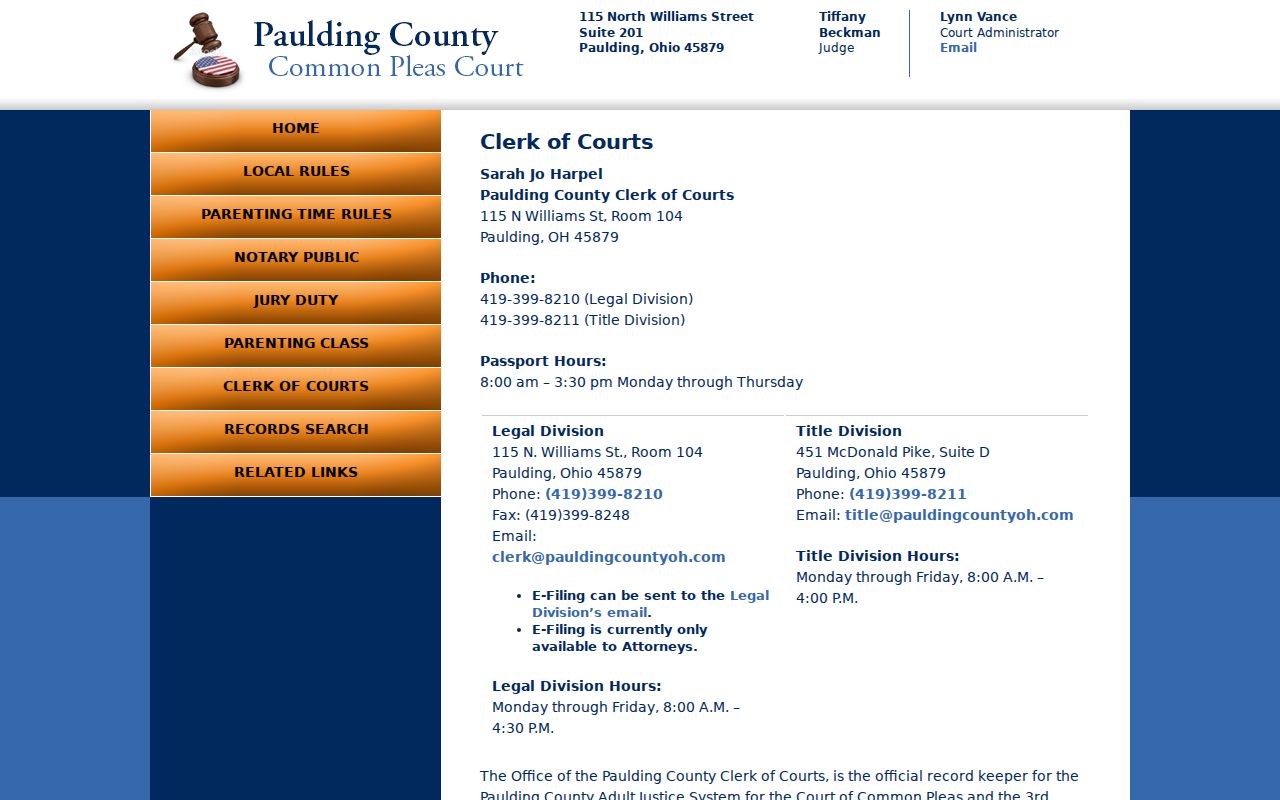
The clerk page draws a line. It separates public case information from electronic filing authority in a Paulding County criminal case.
Municipal Court cases run differently. CaseLook says a person needing verified information may send a request or visit during regular business hours. The court publishes a Public Records Request form. The form offers inspection, pick-up, mail, fax, and certified-copy choices. Inspection is free. The first 24 copies are free. Copies 25 and above run $0.50 each. Certified copies cost $2 per document, and mailing is paid in advance. Those figures apply to the Municipal Court form only, not Common Pleas.
Transcripts are a separate request entirely. Common Pleas Rule 22 places exhibit custody mainly with the official reporter. The court says transcript arrangements and costs are made directly with that reporter. A docket, a filed document, a certified copy, and a transcript are distinct records. They have different custodians.
Access Rules for Criminal Dockets
Ohio presumes public access to court records, but the presumption has limits. Sup.R. 11.09 through 11.17 govern definitions, access, personal identifiers, and restrictions statewide. In Paulding County, eServices and CaseLook can locate public case information, while the right clerk handles direct inspection or an official copy. The Municipal Court warns that its online information may lag 24 hours or more. So a missing web hit does not prove that no case was filed.
Key Ohio access rules:
Ohio Sup.R. 11.09–11.14 establishes the current court-record access and restriction framework, including protected personal information.
R.C. 2303.12 requires Common Pleas clerks to keep case files and a general docket, with stated remote-access duties and exceptions.
R.C. 2953.32 supplies the adult sealing and expungement path, and R.C. 2953.34 limits later inspection of sealed adult records.
The official Ohio sealed-record access statute sets out who may inspect certain adult records once a sealing order is in place.
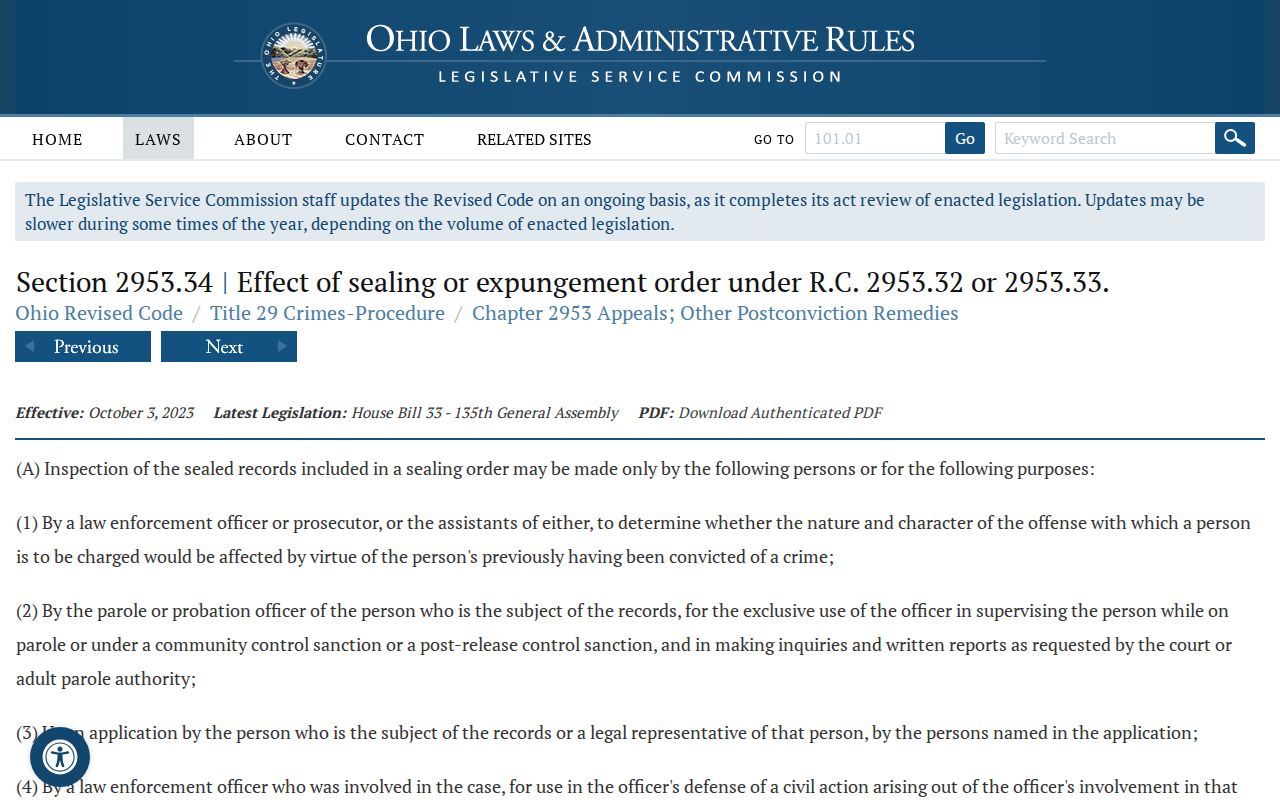
Who can see a sealed criminal record is decided by statute and by court order. A general web search will not override either one. Sealed or expunged adult records can drop out of public indexes. Juvenile records sit under separate statutory limits. Family and child material gets its own protections. Following a Paulding County criminal docket is fine for tracking a public court matter or answering your own court question. But it is no substitute for an official record request when you need a usable copy.
The order-based route that changes public index access comes straight from the Ohio adult sealing and expungement statute. It sets out how that works.
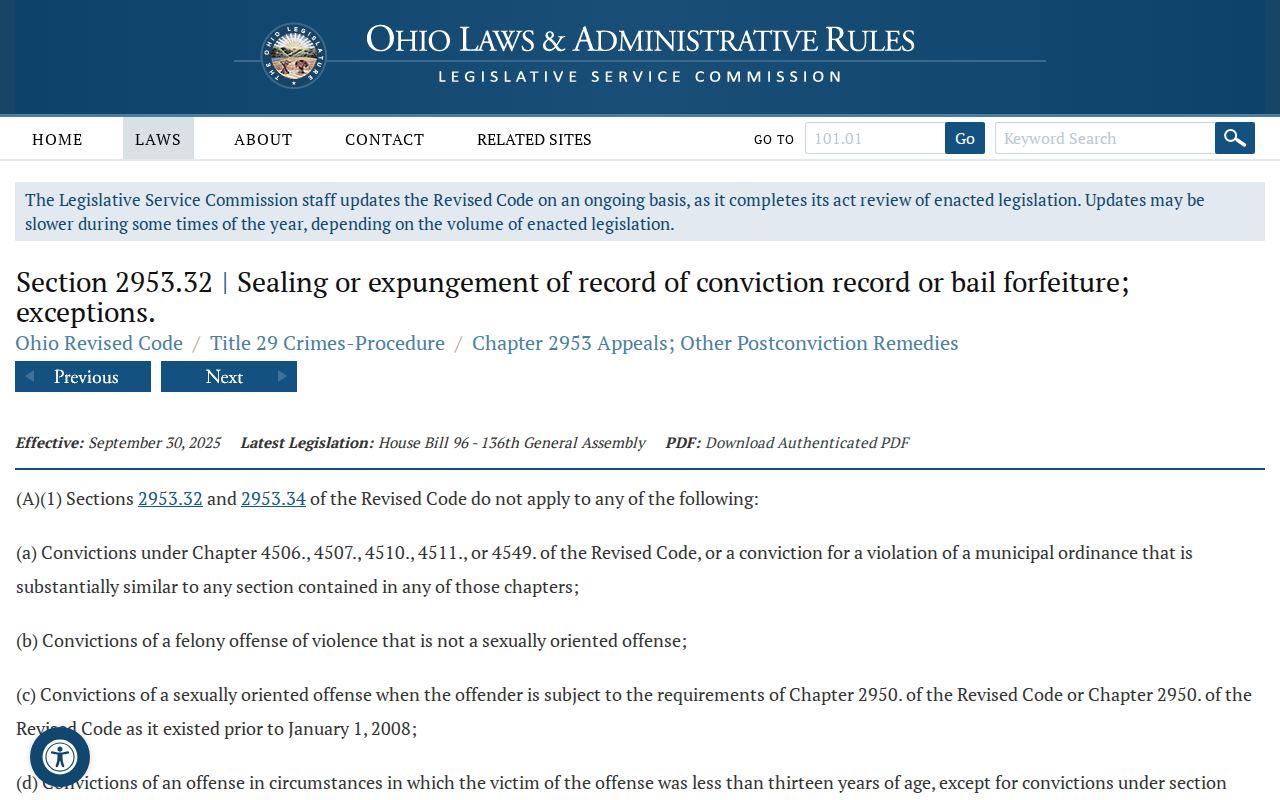
The statute sits inside Ohio's wider framework for sealing and expungement. That structure shapes public criminal docket access here. It also explains the rule numbering on the docket.
Note: Older materials may cite former Sup.R. 44–47, but Ohio's July 2026 restructuring uses the current Sup.R. 11.09–11.17 numbering.
Paulding County Criminal Drug Docket
Paulding Common Pleas Rule 30 creates an Adult Drug Court. The Supreme Court's specialized-docket material also confirms a certified drug docket in Paulding County. Think of it as a specialty track with eligibility conditions. It is not a second, all-purpose criminal court. For a Paulding County criminal docket search, start with the underlying felony case. That case is still the real record.
No public roster of participants exists. There is no second public case number either. The certified drug docket posts no current calendar, program length, staff list, or graduation criteria. Treatment and supervision entries can be more sensitive than a plain caption or court setting. So search the underlying case with care. Ask the Legal Division about the access status of any specific record. Do not assume specialty-docket material is open to everyone.
A final Common Pleas order can be reviewed by the Ohio Third District Court of Appeals. That court serves Paulding County. The Legal Division also keeps the appellate records described on its official page. Any criminal docket search should keep the trial-court case and the appeal record distinct.